
Best for
- Use when working directly with the `esm` Python SDK, ESM3 or ESMC model IDs, Forge/Biohub inference clients, or ESMFold2 folding workflows.
K-Dense-AI/scientific-agent-skills/skills/esm/SKILL.md
Use when working directly with the `esm` Python SDK, ESM3 or ESMC model IDs, Forge/Biohub inference clients, or ESMFold2 folding workflows.
Decision brief
Use when working directly with the `esm` Python SDK, ESM3 or ESMC model IDs, Forge/Biohub inference clients, or ESMFold2 folding workflows.
In this controlled same-task single run, enabling esm changed the output from 2408 non-whitespace characters and 13 headings to 2904 characters and 13 headings. Matches among 8 signals extracted from the pinned source changed from 0 to 0. Both actual outputs are shown; this is a structural observation, not a quality score or a universal performance claim.
Create an implementation guide for adding a webhook retry queue to a TypeScript service. Include prerequisites, steps, verification, and common mistakes. The deliverable must specifically reflect this user intent: Use when working directly with the `esm` Python SDK, ESM3 or ESMC model IDs, Forge/Biohub inference clients, or ESMFold2 folding workflows.
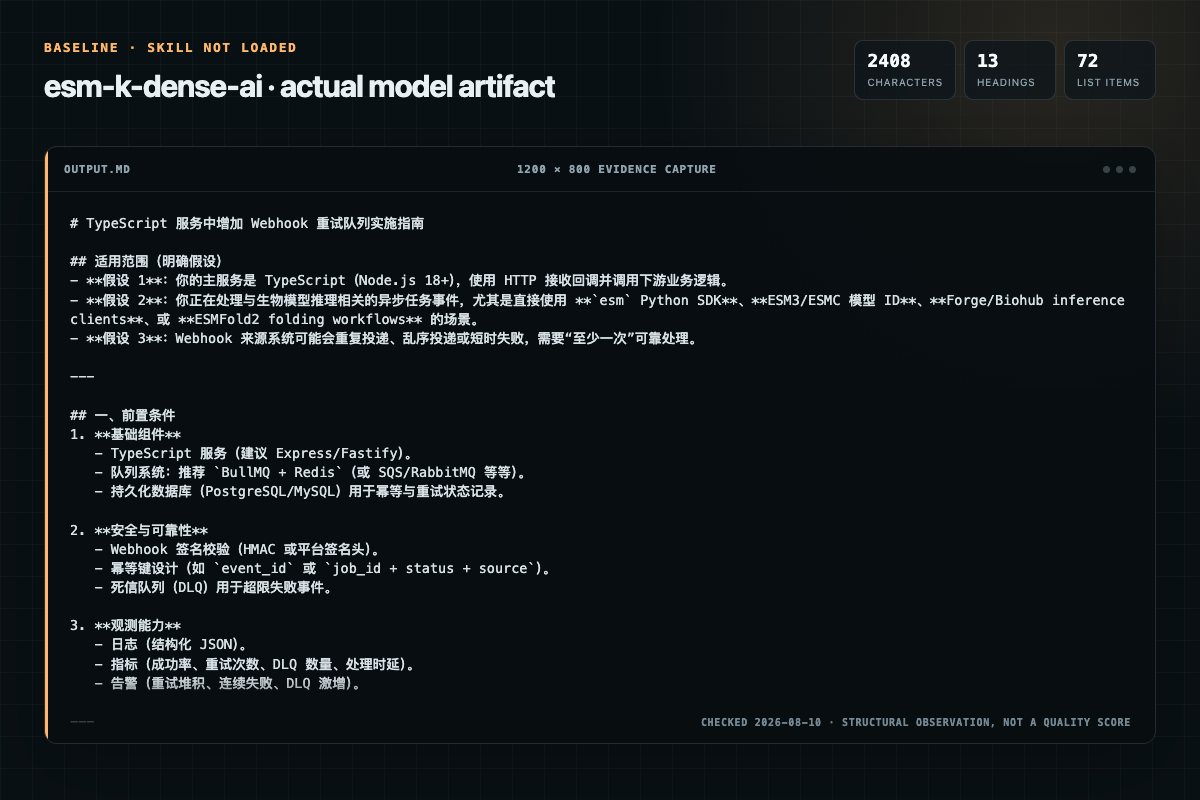
Baseline: 2408 non-whitespace characters, 13 headings, and 72 list items.
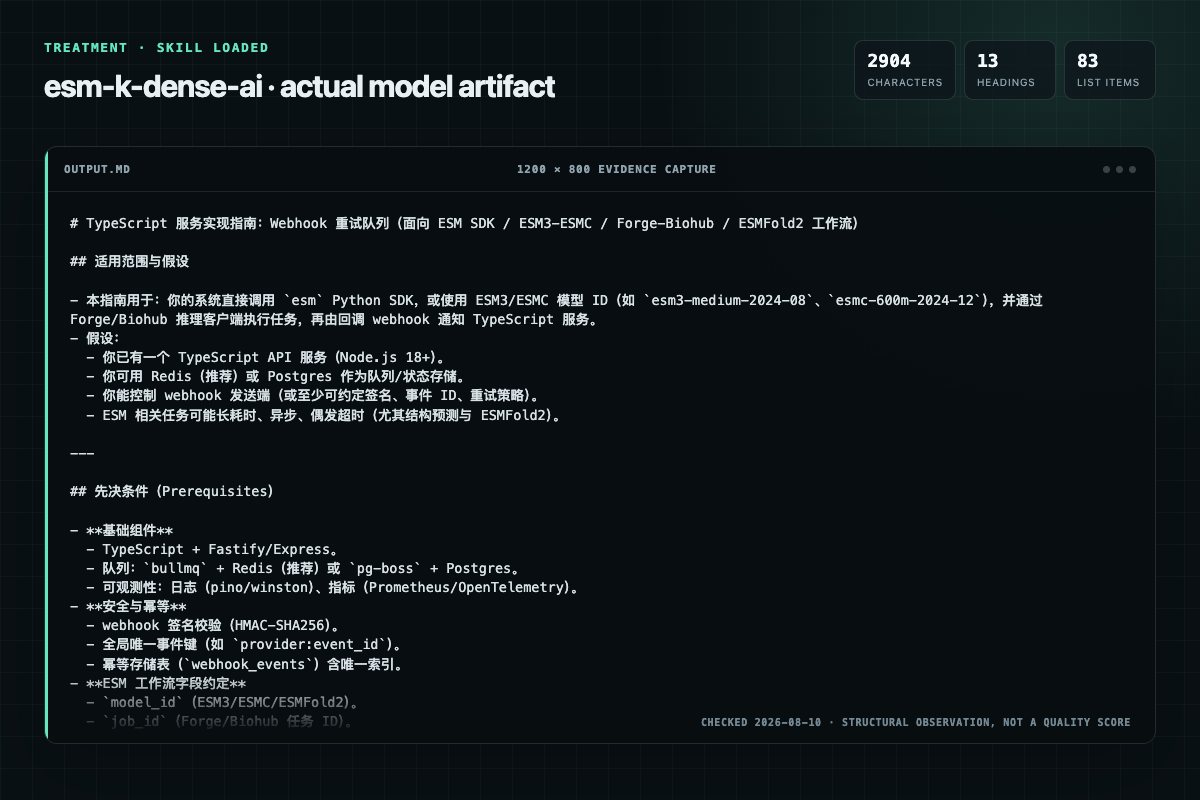
With Skill: 2904 non-whitespace characters, 13 headings, and 83 list items.
| Observation | Without Skill | With Skill |
|---|---|---|
| Source-signal coverage | 0/8: none | 0/8: none |
| Output structure | 2408 chars · 13 headings · 72 list items · 0 code blocks | 2904 chars · 13 headings · 83 list items · 0 code blocks |
| Verification and caution signals | 18 verification signals · 7 risk/limitation signals | 12 verification signals · 4 risk/limitation signals |
Use the esm Skill pinned at 390f5146bf3c for my task. Follow its source-specific constraints around `evolutionary`, `scale`, `modeling`, `capabilities`, then return the finished deliverable with explicit assumptions, verification, failure conditions, and limits. Do not treat the Skill text as a factual source or claim that a single demonstration proves universal performance.
Compatibility matrix
| Platform | Status | Evidence | What to check |
|---|---|---|---|
| Codex | Not declared | No explicit evidence | Portability before use |
| Claude Code | Not declared | No explicit evidence | Portability before use |
| Cursor | Not declared | No explicit evidence | Portability before use |
| Gemini CLI | Not declared | No explicit evidence | Portability before use |
Installation
The source command is displayed only when detected. A safe inspection prompt is always available so your agent can explain every action before execution.
npx skills add https://github.com/K-Dense-AI/scientific-agent-skills --skill "skills/esm"Inspect the Agent Skill "esm" from https://github.com/K-Dense-AI/scientific-agent-skills/blob/36d8f13a1e754618794bf42f417884940077b4ae/skills/esm/SKILL.md at commit 36d8f13a1e754618794bf42f417884940077b4ae. List every install step, command, network request, credential, file read/write, external action, and rollback step. Explain whether it fits my task. Do not install or execute anything until I approve.
Workflow
protein = ESMProtein(sequence="MPRT" + "" 100 + "KEND")
config = GenerationConfig(track="structure", numsteps=50) protein = model.generate(protein, config)
config = GenerationConfig(track="sequence", numsteps=50, temperature=0.5) protein = model.generate(protein, config)
config = GenerationConfig(track="function", numsteps=20) protein = model.generate(protein, config) python import os import asyncio import esm from esm.sdk.api import ESMProtein, GenerationConfig
Generate novel protein sequences with desired properties using multimodal generative modeling.
Permission review
No configured static risk pattern was detected
This is not proof of safety. Runtime behavior, indirect dependencies, and hidden external systems are outside the static scan.
Evidence record
| Signal | Value | Evidence type | Meaning |
|---|---|---|---|
| Quality score | 97/100 | Computed | Documentation, specificity, maintenance, and trust rules |
| Repository stars | 36,049 | Source | Repository attention, not individual Skill quality |
| Compatibility | 0 platforms | Source | Declared in the catalog source record |
| Usage guide | tested outcome page | Tested | Generated or reviewed according to the visible evidence level |
Pinned source
ESM provides protein language models for understanding, generating, and designing proteins. Use this skill for current EvolutionaryScale/Biohub workflows: ESM3 for generative design, ESMC for representation learning and embeddings, hosted Forge/Biohub inference, and ESMFold2 all-atom structure prediction.
Generate novel protein sequences with desired properties using multimodal generative modeling.
When to use:
Basic usage:
from esm.models.esm3 import ESM3
from esm.sdk.api import ESM3InferenceClient, ESMProtein, GenerationConfig

# Load local open weights after accepting the license on Hugging Face.
model: ESM3InferenceClient = ESM3.from_pretrained("esm3-open").to("cuda")

# Create protein prompt
protein = ESMProtein(sequence="MPRT___KEND")  # '_' represents masked positions

# Generate completion
protein = model.generate(protein, GenerationConfig(track="sequence", num_steps=8))
print(protein.sequence)
For remote/cloud usage via Forge API:
import os
import esm
from esm.sdk.api import ESMProtein, GenerationConfig

# Same interface as local ESM3; token from ESM_API_KEY (see Authentication)
model = esm.sdk.client("esm3-medium-2024-08", token=os.environ["ESM_API_KEY"])

# Generate
protein = model.generate(protein, GenerationConfig(track="sequence", num_steps=8))
See references/esm3-api.md for detailed ESM3 model specifications, advanced generation configurations, and multimodal prompting examples.
Use ESM3's structure track for structure prediction from sequence or inverse folding (sequence design from structure).
Structure prediction:
from esm.sdk.api import ESM3InferenceClient, ESMProtein, GenerationConfig

# Predict structure from sequence
protein = ESMProtein(sequence="MPRTKEINDAGLIVHSP...")
protein_with_structure = model.generate(
    protein,
    GenerationConfig(track="structure", num_steps=protein.sequence.count("_"))
)

# Access predicted structure
coordinates = protein_with_structure.coordinates  # 3D coordinates
pdb_string = protein_with_structure.to_pdb()
Inverse folding (sequence from structure):
# Design sequence for a target structure
protein_with_structure = ESMProtein.from_pdb("target_structure.pdb")
protein_with_structure.sequence = None  # Remove sequence

# Generate sequence that folds to this structure
designed_protein = model.generate(
    protein_with_structure,
    GenerationConfig(track="sequence", num_steps=50, temperature=0.7)
)
Generate high-quality embeddings for downstream tasks like function prediction, classification, or similarity analysis.
When to use:
Basic usage:
from esm.models.esmc import ESMC
from esm.sdk.api import ESMProtein, LogitsConfig

# Load ESM C model
model = ESMC.from_pretrained("esmc_300m").to("cuda")

# Get embeddings
protein = ESMProtein(sequence="MPRTKEINDAGLIVHSP...")
protein_tensor = model.encode(protein)
logits_output = model.logits(
    protein_tensor,
    LogitsConfig(sequence=True, return_embeddings=True),
)
embeddings = logits_output.embeddings
Batch processing:
# Encode multiple proteins
proteins = [
    ESMProtein(sequence="MPRTKEIND..."),
    ESMProtein(sequence="AGLIVHSPQ..."),
    ESMProtein(sequence="KTEFLNDGR...")
]

embeddings_list = [
    model.logits(
        model.encode(p),
        LogitsConfig(sequence=True, return_embeddings=True),
    ).embeddings
    for p in proteins
]
See references/esm-c-api.md for ESM C model details, efficiency comparisons, and advanced embedding strategies.
Use ESM3's function track to generate proteins with specific functional annotations or predict function from sequence.
Function-conditioned generation:
from esm.sdk.api import ESMProtein, FunctionAnnotation, GenerationConfig

# Create protein with desired function
protein = ESMProtein(
    sequence="_" * 200,  # Generate 200 residue protein
    function_annotations=[
        FunctionAnnotation(label="fluorescent_protein", start=50, end=150)
    ]
)

# Generate sequence with specified function
functional_protein = model.generate(
    protein,
    GenerationConfig(track="sequence", num_steps=200)
)
Iteratively refine protein designs using ESM3's chain-of-thought generation approach.
from esm.sdk.api import GenerationConfig

# Multi-step refinement
protein = ESMProtein(sequence="MPRT" + "_" * 100 + "KEND")

# Step 1: Generate initial structure
config = GenerationConfig(track="structure", num_steps=50)
protein = model.generate(protein, config)

# Step 2: Refine sequence based on structure
config = GenerationConfig(track="sequence", num_steps=50, temperature=0.5)
protein = model.generate(protein, config)

# Step 3: Predict function
config = GenerationConfig(track="function", num_steps=20)
protein = model.generate(protein, config)
Process multiple proteins efficiently using Forge's async methods.
import os
import asyncio
import esm
from esm.sdk.api import ESMProtein, GenerationConfig

client = esm.sdk.client("esm3-medium-2024-08", token=os.environ["ESM_API_KEY"])

# Async batch processing
async def batch_generate(proteins_list):
    tasks = [
        client.async_generate(protein, GenerationConfig(track="sequence"))
        for protein in proteins_list
    ]
    return await asyncio.gather(*tasks)

# Execute
proteins = [ESMProtein(sequence=f"MPRT{'_' * 50}KEND") for _ in range(10)]
results = asyncio.run(batch_generate(proteins))
See references/forge-api.md for detailed Forge API documentation, authentication, rate limits, and batch processing patterns.
ESM3 Models (Generative):
esm3-open (1.4B) - Open weights, local usage after accepting the Hugging Face licenseesm3-medium-2024-08 (7B) - Best balance of quality and speed (Forge only)esm3-large-2024-03 (98B) - Highest quality, slower (Forge only)ESM C Models (Embeddings):
esmc_300m / esmc-300m-2024-12 (30 layers) - Lightweight, fast inference (open weights, local)esmc_600m / esmc-600m-2024-12 (36 layers) - Balanced performance (open weights, local)esmc-6b-2024-12 (80 layers) - Maximum quality (Forge API; local 6B weights require Forge or SageMaker)Local ESMC.from_pretrained() examples use underscore aliases (esmc_300m, esmc_600m). Hosted API clients use dated model IDs such as esmc-600m-2024-12.
Selection criteria:
esm3-open or esmc_300mesm3-medium-2024-08 via Forgeesm3-large-2024-03 or esmc-6b-2024-12 via ForgeInstall from PyPI (esm on PyPI by EvolutionaryScale). Current PyPI release: 3.2.3 (Oct 14, 2025). Requires Python >=3.12,<3.13.
Basic installation:
uv pip install "esm==3.2.3"
With Flash Attention (recommended for faster inference on NVIDIA GPUs):
uv pip install "esm==3.2.3"
uv pip install flash-attn --no-build-isolation
The Forge client ships with the esm package - no extra install for ESM3 or ESMC Forge inference.
Forge API access requires an API key. Never hardcode tokens in scripts or commit them to version control.
ESM_API_KEY is already set in the environment..env for ESM_API_KEY only (do not load unrelated secrets).import os
token = os.environ["ESM_API_KEY"] # raises KeyError if unset
esm.sdk.client() reads ESM_API_KEY automatically when token is omitted. Keep endpoint URLs fixed to trusted hosts such as https://forge.evolutionaryscale.ai or https://biohub.ai; do not take API hosts from untrusted user input.
Biohub platform: EvolutionaryScale and Forge now surface current hosted models through biohub.ai. SDK class names may still reference "Forge". See references/biohub-platform.md for ESMFold2 and Biohub-specific setup.
For detailed examples and complete workflows, see references/workflows.md which includes:
This skill includes comprehensive reference documentation:
references/esm3-api.md - ESM3 model architecture, API reference, generation parameters, and multimodal promptingreferences/esm-c-api.md - ESM C model details, embedding strategies, and performance optimizationreferences/forge-api.md - Forge platform documentation, authentication, batch processing, and deploymentreferences/biohub-platform.md - Biohub API migration, ESMFold2 structure prediction, and developer-console authreferences/workflows.md - Complete examples and common workflow patternsThese references contain detailed API specifications, parameter descriptions, and advanced usage patterns. Load them as needed for specific tasks.
For generation tasks:
esm3-open)For embedding tasks:
For production deployment:
ESM is designed for beneficial applications in protein engineering, drug discovery, and scientific research. Follow the Responsible Biodesign Framework (https://responsiblebiodesign.ai/) and Biohub Acceptable Use Policy (https://biohub.org/acceptable-use-policy/) when designing novel proteins. Consider biosafety and ethical implications of protein designs before experimental validation.
Frequently asked questions
Use when working directly with the `esm` Python SDK, ESM3 or ESMC model IDs, Forge/Biohub inference clients, or ESMFold2 folding workflows.
The source record exposes this install command: npx skills add https://github.com/K-Dense-AI/scientific-agent-skills --skill "skills/esm". Inspect the command and pinned source before running it.
Alternatives
synthetic-sciences/openscience
Comprehensive toolkit for protein language models including ESM3 (generative multimodal protein design across sequence, structure, and function) and ESM C (efficient protein embeddings and representations). Use this skill when working with protein sequences, structures, or function prediction; designing novel proteins; generating protein embeddings; performing inverse folding; or conducting protein engineering tasks. Supports both local model usage and cloud-based Forge API for scalable inferenc
Jamie-BitFlight/claude_skills
Use when building Python 3.11+ CLI apps (Typer/Rich), writing pytest test suites, fixing ruff linting or ty/mypy type errors, configuring pyproject.toml, creating portable scripts, or reviewing Python code. Activates on all Python implementation tasks — routes to specialist agents for CLI architecture, test design, packaging, and code review. Authoritative reference for modern Python 3.11-3.14 patterns and TDD workflows.
Jamie-BitFlight/claude_skills
Use when building, extending, or debugging FastMCP v3 Python MCP servers. Activates on FastMCP tool/resource/prompt creation, provider and transform implementation (CodeMode, Tool Search), auth setup (MultiAuth, PropelAuth, KeycloakProvider), client SDK usage, FastMCPApp and Generative UI server building, fastmcp-slim client-only installs, nginx reverse proxy deployment, Prefab Apps, OTEL observability, and testing. Grounded in local v3.3 docs — zero speculation.
Borda/AI-Rig
Multi-agent code review of local Python files, directories, or the current git diff covering architecture, tests, performance, docs, lint, security, and API design. Scope: Python source files in local working tree. Python-file-free targets (pure JS/TS/Go/Rust projects) are out of scope. TRIGGER when: user asks to review local Python files, a directory, or the current git diff/working-tree changes, with no GitHub PR number involved; phrases: "review this", "review my changes", "code review this d