
Best for
- Building REST APIs with FastAPI
- Implementing Pydantic V2 validation schemas
- Setting up async database operations
Jeffallan/claude-skills/skills/fastapi-expert/SKILL.md
Use when building high-performance async Python APIs with FastAPI and Pydantic V2. Invoke to create REST endpoints, define Pydantic models, implement authentication flows, set up async SQLAlchemy database operations, add JWT authentication, build WebSocket endpoints, or generate OpenAPI documentation. Trigger terms: FastAPI, Pydantic, async Python, Python API, REST API Python, SQLAlchemy async, JWT authentication, OpenAPI, Swagger Python.
Decision brief
Deep expertise in async Python, Pydantic V2, and production-grade API development with FastAPI.
In this controlled same-task single run, enabling fastapi-expert changed the output from 2472 non-whitespace characters and 15 headings to 3034 characters and 17 headings. Matches among 8 signals extracted from the pinned source changed from 1 to 1. Both actual outputs are shown; this is a structural observation, not a quality score or a universal performance claim.
Create an implementation guide for adding a webhook retry queue to a TypeScript service. Include prerequisites, steps, verification, and common mistakes. The deliverable must specifically reflect this user intent: Use when building high-performance async Python APIs with FastAPI and Pydantic V2. Invoke to create REST endpoints, define Pydantic models, implement authentication flows, set up async SQLAlchemy database operations, add JWT authentication, build WebSocket endpoints, or generate OpenAPI documentation. Trigger terms: FastAPI, Pydantic, async Python, Python API, REST API Python, SQLAlchemy async, JWT authentication, OpenAPI, Swagger Python.
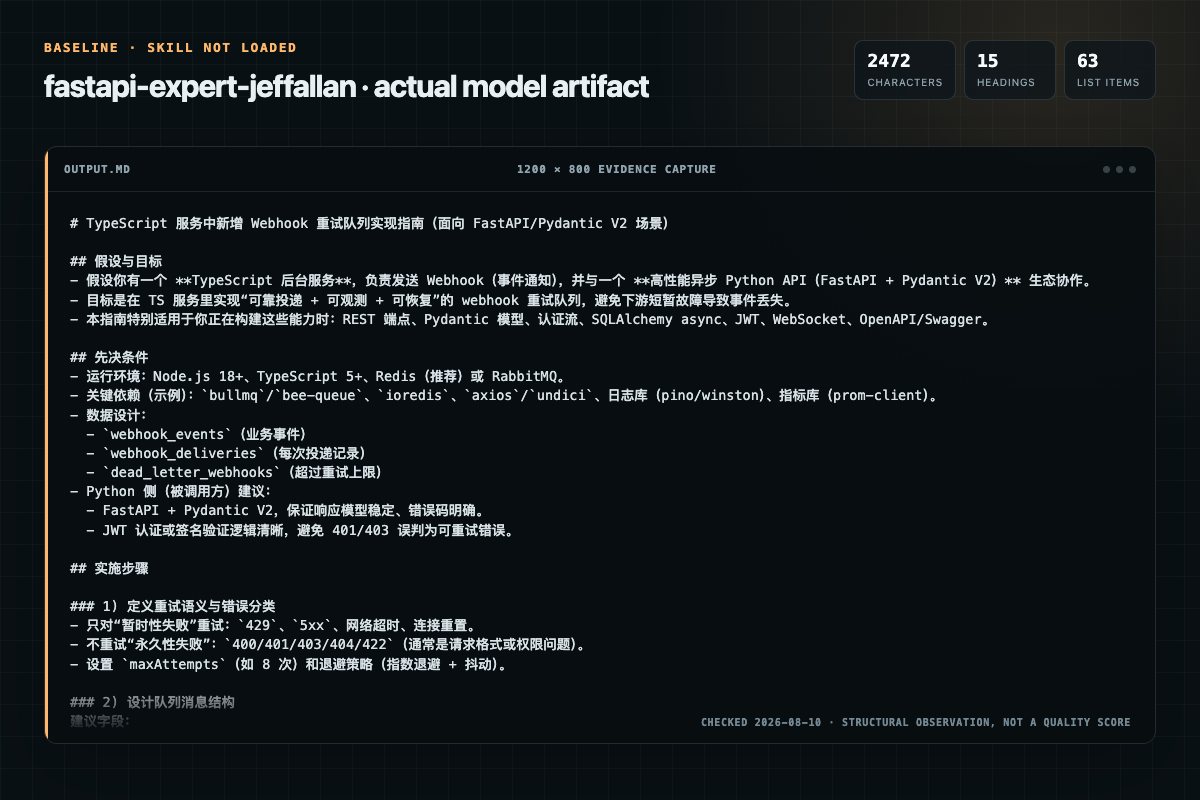
Baseline: 2472 non-whitespace characters, 15 headings, and 63 list items.
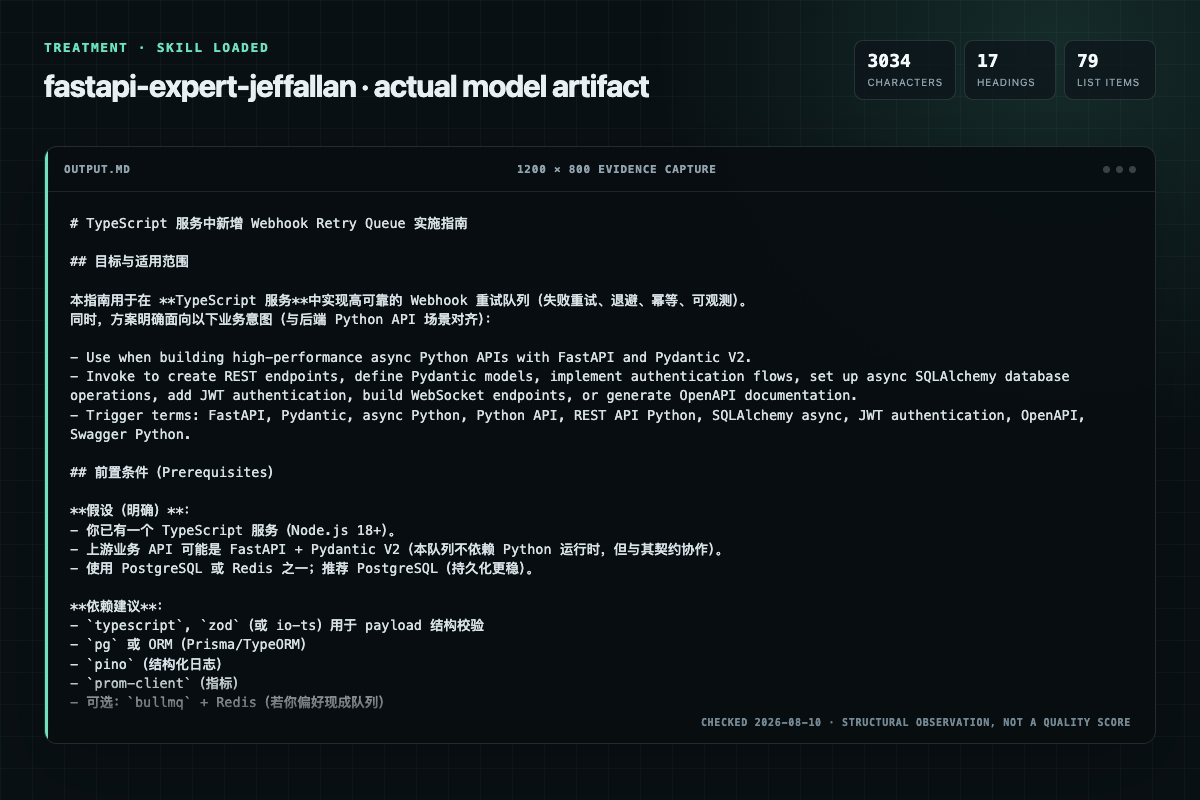
With Skill: 3034 non-whitespace characters, 17 headings, and 79 list items.
| Observation | Without Skill | With Skill |
|---|---|---|
| Source-signal coverage | 1/8: fastapi | 1/8: fastapi |
| Output structure | 2472 chars · 15 headings · 63 list items · 0 code blocks | 3034 chars · 17 headings · 79 list items · 0 code blocks |
| Verification and caution signals | 14 verification signals · 7 risk/limitation signals | 14 verification signals · 1 risk/limitation signals |
Use the fastapi-expert Skill pinned at 882ef55e377d for my task. Follow its source-specific constraints around `fastapi-expert`, `fastapi`, `expert`, `minimal`, then return the finished deliverable with explicit assumptions, verification, failure conditions, and limits. Do not treat the Skill text as a factual source or claim that a single demonstration proves universal performance.
Compatibility matrix
| Platform | Status | Evidence | What to check |
|---|---|---|---|
| Codex | Not declared | No explicit evidence | Portability before use |
| Claude Code | Not declared | No explicit evidence | Portability before use |
| Cursor | Not declared | No explicit evidence | Portability before use |
| Gemini CLI | Not declared | No explicit evidence | Portability before use |
Installation
The source command is displayed only when detected. A safe inspection prompt is always available so your agent can explain every action before execution.
npx skills add https://github.com/Jeffallan/claude-skills --skill "skills/fastapi-expert"Inspect the Agent Skill "fastapi-expert" from https://github.com/Jeffallan/claude-skills/blob/882ef55e377dbf9a4dbe496bb41ac6ccd0e555cf/skills/fastapi-expert/SKILL.md at commit 882ef55e377dbf9a4dbe496bb41ac6ccd0e555cf. List every install step, command, network request, credential, file read/write, external action, and rollback step. Explain whether it fits my task. Do not install or execute anything until I approve.
Workflow
1. Analyze requirements — Identify endpoints, data models, auth needs 2. Design schemas — Create Pydantic V2 models for validation 3. Implement — Write async endpoints with proper dependency injection 4. Secure — Add authentication, authorization, rate limiting 5. Test — Write a…
Building REST APIs with FastAPI
Schema + endpoint + dependency injection in one cohesive unit:
from pydantic import BaseModel, EmailStr, fieldvalidator, modelconfig
from fastapi import APIRouter, Depends, HTTPException, status from sqlalchemy.ext.asyncio import AsyncSession from typing import Annotated
Permission review
No configured static risk pattern was detected
This is not proof of safety. Runtime behavior, indirect dependencies, and hidden external systems are outside the static scan.
Evidence record
| Signal | Value | Evidence type | Meaning |
|---|---|---|---|
| Quality score | 98/100 | Computed | Documentation, specificity, maintenance, and trust rules |
| Repository stars | 11,220 | Source | Repository attention, not individual Skill quality |
| Compatibility | 0 platforms | Source | Declared in the catalog source record |
| Usage guide | tested outcome page | Tested | Generated or reviewed according to the visible evidence level |
Pinned source
Deep expertise in async Python, Pydantic V2, and production-grade API development with FastAPI.
pytest after each endpoint group and verify OpenAPI docs at /docsCheckpoint after each step: confirm schemas validate correctly, endpoints return expected HTTP status codes, and
/docsreflects the intended API surface before proceeding.
Schema + endpoint + dependency injection in one cohesive unit:
# schemas.py
from pydantic import BaseModel, EmailStr, field_validator, model_config

class UserCreate(BaseModel):
    model_config = model_config(str_strip_whitespace=True)

    email: EmailStr
    password: str
    name: str | None = None

    @field_validator("password")
    @classmethod
    def password_strength(cls, v: str) -> str:
        if len(v) < 8:
            raise ValueError("Password must be at least 8 characters")
        return v

class UserResponse(BaseModel):
    model_config = model_config(from_attributes=True)

    id: int
    email: EmailStr
    name: str | None = None
# routers/users.py
from fastapi import APIRouter, Depends, HTTPException, status
from sqlalchemy.ext.asyncio import AsyncSession
from typing import Annotated

from app.database import get_db
from app.schemas import UserCreate, UserResponse
from app import crud

router = APIRouter(prefix="/users", tags=["users"])

DbDep = Annotated[AsyncSession, Depends(get_db)]

@router.post("/", response_model=UserResponse, status_code=status.HTTP_201_CREATED)
async def create_user(payload: UserCreate, db: DbDep) -> UserResponse:
    existing = await crud.get_user_by_email(db, payload.email)
    if existing:
        raise HTTPException(status_code=status.HTTP_409_CONFLICT, detail="Email already registered")
    return await crud.create_user(db, payload)
# crud.py
from sqlalchemy import select
from sqlalchemy.ext.asyncio import AsyncSession
from app.models import User
from app.schemas import UserCreate
from app.security import hash_password

async def get_user_by_email(db: AsyncSession, email: str) -> User | None:
    result = await db.execute(select(User).where(User.email == email))
    return result.scalar_one_or_none()

async def create_user(db: AsyncSession, payload: UserCreate) -> User:
    user = User(email=payload.email, hashed_password=hash_password(payload.password), name=payload.name)
    db.add(user)
    await db.commit()
    await db.refresh(user)
    return user
# security.py
from datetime import datetime, timedelta, timezone
from jose import JWTError, jwt
from fastapi import Depends, HTTPException, status
from fastapi.security import OAuth2PasswordBearer
from typing import Annotated

SECRET_KEY = "read-from-env"  # use os.environ / settings
ALGORITHM = "HS256"
oauth2_scheme = OAuth2PasswordBearer(tokenUrl="/auth/token")

def create_access_token(subject: str, expires_delta: timedelta = timedelta(minutes=30)) -> str:
    payload = {"sub": subject, "exp": datetime.now(timezone.utc) + expires_delta}
    return jwt.encode(payload, SECRET_KEY, algorithm=ALGORITHM)

async def get_current_user(token: Annotated[str, Depends(oauth2_scheme)]) -> str:
    try:
        data = jwt.decode(token, SECRET_KEY, algorithms=[ALGORITHM])
        subject: str | None = data.get("sub")
        if subject is None:
            raise ValueError
        return subject
    except (JWTError, ValueError):
        raise HTTPException(status_code=status.HTTP_401_UNAUTHORIZED, detail="Invalid credentials")

CurrentUser = Annotated[str, Depends(get_current_user)]
Load detailed guidance based on context:
| Topic | Reference | Load When |
|---|---|---|
| Pydantic V2 | references/pydantic-v2.md | Creating schemas, validation, model_config |
| SQLAlchemy | references/async-sqlalchemy.md | Async database, models, CRUD operations |
| Endpoints | references/endpoints-routing.md | APIRouter, dependencies, routing |
| Authentication | references/authentication.md | JWT, OAuth2, get_current_user |
| Testing | references/testing-async.md | pytest-asyncio, httpx, fixtures |
| Django Migration | references/migration-from-django.md | Migrating from Django/DRF to FastAPI |
field_validator, model_validator, model_config)Annotated pattern for dependency injectionX | None instead of Optional[X]@validator, class Config)When implementing FastAPI features, provide:
FastAPI, Pydantic V2, async SQLAlchemy, Alembic migrations, JWT/OAuth2, pytest-asyncio, httpx, BackgroundTasks, WebSockets, dependency injection, OpenAPI/Swagger
Frequently asked questions
Deep expertise in async Python, Pydantic V2, and production-grade API development with FastAPI.
The source record exposes this install command: npx skills add https://github.com/Jeffallan/claude-skills --skill "skills/fastapi-expert". Inspect the command and pinned source before running it.
Alternatives
alirezarezvani/claude-skills
Reverse-engineer any codebase into a complete Product Requirements Document (PRD). Analyzes routes, components, state management, API integrations, and user interactions to produce business-readable documentation detailed enough for engineers or AI agents to fully reconstruct every page and endpoint. Works with frontend frameworks (React, Vue, Angular, Svelte, Next.js, Nuxt), backend frameworks (NestJS, Django, Express, FastAPI), and fullstack applications. Use when users mention: generate PRD,
almanak-co/sdk
Build, test, and deploy DeFi trading strategies using the Almanak SDK. ALWAYS use this skill when the user mentions almanak, DeFi strategy, trading strategy, yield farming, liquidity provision, token swap, borrowing, lending, perpetuals, staking, vault deposit, bridging tokens, backtesting, paper trading, or on-chain execution. Use for writing strategy.py files, composing intents (Swap, LP, Borrow, Supply, Perp, Bridge, Stake, Vault, Prediction), working with config.json strategy parameters, run
SpartanLabsXyz/simmer-sdk
Generate complete, installable OpenClaw trading skills from natural language strategy descriptions. Use when your human wants to create a new trading strategy, build a bot, generate a skill, automate a trade idea, turn a tweet into a strategy, or asks "build me a skill that...". Produces a full skill folder (SKILL.md + Python script + config) ready to install and run.
Borda/AI-Rig
Multi-agent code review of local Python files, directories, or the current git diff covering architecture, tests, performance, docs, lint, security, and API design. Scope: Python source files in local working tree. Python-file-free targets (pure JS/TS/Go/Rust projects) are out of scope. TRIGGER when: user asks to review local Python files, a directory, or the current git diff/working-tree changes, with no GitHub PR number involved; phrases: "review this", "review my changes", "code review this d