
Best for
- Adding retry logic to external service calls
- Implementing timeouts for network operations
- Building fault-tolerant microservices
wshobson/agents/plugins/python-development/skills/python-resilience/SKILL.md
Python resilience patterns including automatic retries, exponential backoff, timeouts, and fault-tolerant decorators. Use when adding retry logic, implementing timeouts, building fault-tolerant services, or handling transient failures.
Decision brief
Build fault-tolerant Python applications that gracefully handle transient failures, network issues, and service outages. Resilience patterns keep systems running when dependencies are unreliable.
In this controlled same-task single run, enabling python-resilience changed the output from 3778 non-whitespace characters and 6 headings to 3739 characters and 7 headings. Matches among 8 signals extracted from the pinned source changed from 2 to 1. Both actual outputs are shown; this is a structural observation, not a quality score or a universal performance claim.
Design and implement a representative production change for a TypeScript webhook retry service. Include the key code or pseudocode, tradeoffs, and verification steps. The deliverable must specifically reflect this user intent: Python resilience patterns including automatic retries, exponential backoff, timeouts, and fault-tolerant decorators. Use when adding retry logic, implementing timeouts, building fault-tolerant services, or handling transient failures.
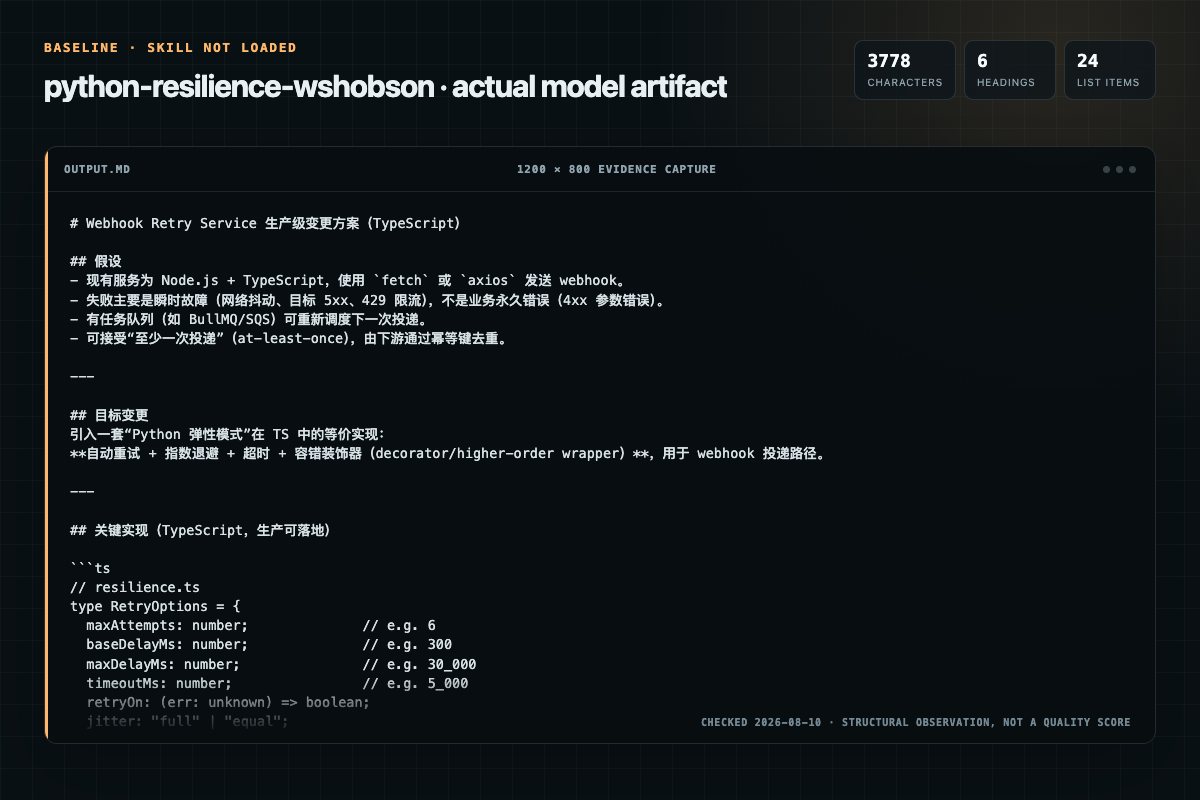
Baseline: 3778 non-whitespace characters, 6 headings, and 24 list items.
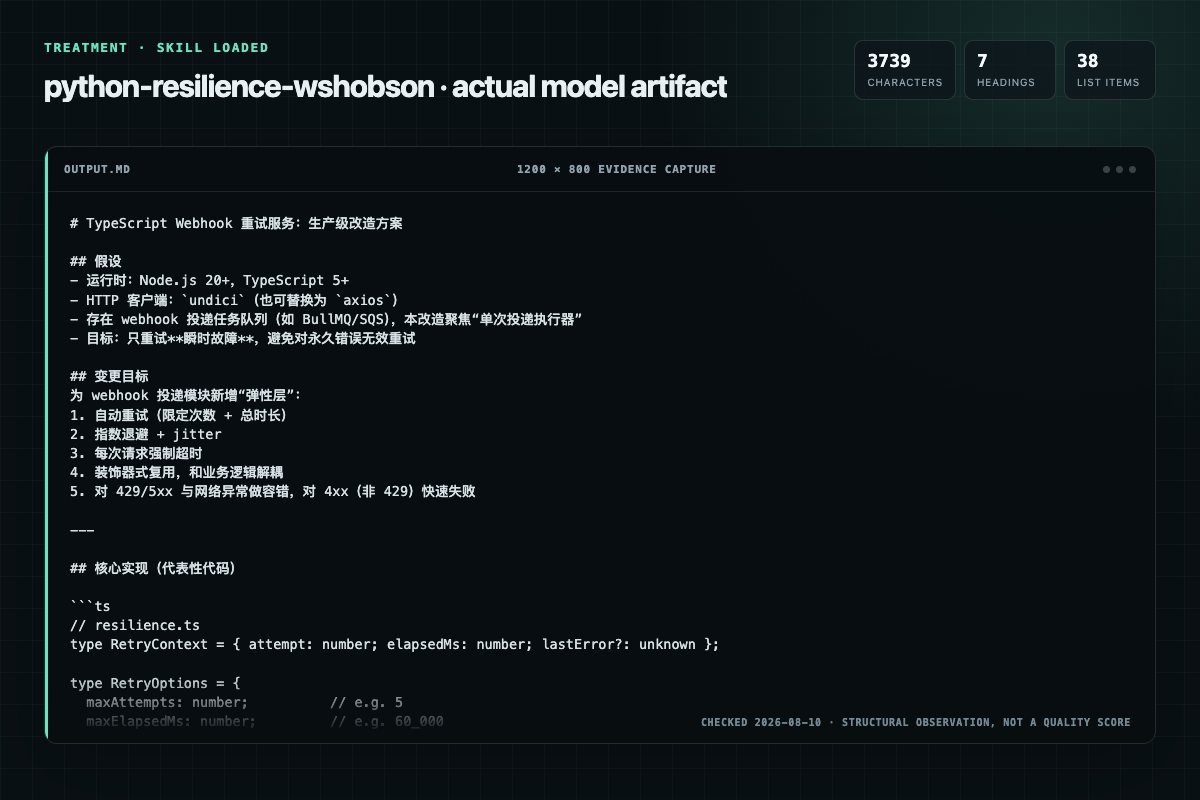
With Skill: 3739 non-whitespace characters, 7 headings, and 38 list items.
| Observation | Without Skill | With Skill |
|---|---|---|
| Source-signal coverage | 2/8: python, resilience | 1/8: resilience |
| Output structure | 3778 chars · 6 headings · 24 list items · 3 code blocks | 3739 chars · 7 headings · 38 list items · 2 code blocks |
| Verification and caution signals | 10 verification signals · 2 risk/limitation signals | 12 verification signals · 5 risk/limitation signals |
Use the python-resilience Skill pinned at 367cb6a4a182 for my task. Follow its source-specific constraints around `python-resilience`, `python`, `resilience`, `patterns`, then return the finished deliverable with explicit assumptions, verification, failure conditions, and limits. Do not treat the Skill text as a factual source or claim that a single demonstration proves universal performance.
Compatibility matrix
| Platform | Status | Evidence | What to check |
|---|---|---|---|
| Codex | Not declared | No explicit evidence | Portability before use |
| Claude Code | Not declared | No explicit evidence | Portability before use |
| Cursor | Not declared | No explicit evidence | Portability before use |
| Gemini CLI | Not declared | No explicit evidence | Portability before use |
Installation
The source command is displayed only when detected. A safe inspection prompt is always available so your agent can explain every action before execution.
npx skills add https://github.com/wshobson/agents --skill "plugins/python-development/skills/python-resilience"Inspect the Agent Skill "python-resilience" from https://github.com/wshobson/agents/blob/38e19c20d2b154510b0e624a2e3e186b19b5c527/plugins/python-development/skills/python-resilience/SKILL.md at commit 38e19c20d2b154510b0e624a2e3e186b19b5c527. List every install step, command, network request, credential, file read/write, external action, and rollback step. Explain whether it fits my task. Do not install or execute anything until I approve.
Workflow
Review the “Quick Start” section in the pinned source before continuing.
Adding retry logic to external service calls
Retry transient errors (network timeouts, temporary service issues). Don't retry permanent errors (invalid credentials, bad requests).
Retry transient errors (network timeouts, temporary service issues). Don't retry permanent errors (invalid credentials, bad requests).
Increase wait time between retries to avoid overwhelming recovering services.
Permission review
The documentation includes network, browsing, or remote request actions.
return httpx.post("https://api.example.com", json=request).json()The documentation includes network, browsing, or remote request actions.
return httpx.request(method, url, timeout=30, **kwargs)The documentation asks the agent to read local files, directories, or repositories.
Detailed sections (starting with `## Advanced Patterns`) live in `references/details.md`. Read that file when the navigation summary above is insufficient.Evidence record
| Signal | Value | Evidence type | Meaning |
|---|---|---|---|
| Quality score | 89/100 | Computed | Documentation, specificity, maintenance, and trust rules |
| Repository stars | 39,220 | Source | Repository attention, not individual Skill quality |
| Compatibility | 0 platforms | Source | Declared in the catalog source record |
| Usage guide | tested outcome page | Tested | Generated or reviewed according to the visible evidence level |
Pinned source
Build fault-tolerant Python applications that gracefully handle transient failures, network issues, and service outages. Resilience patterns keep systems running when dependencies are unreliable.
Retry transient errors (network timeouts, temporary service issues). Don't retry permanent errors (invalid credentials, bad requests).
Increase wait time between retries to avoid overwhelming recovering services.
Add randomness to backoff to prevent thundering herd when many clients retry simultaneously.
Cap both attempt count and total duration to prevent infinite retry loops.
from tenacity import retry, stop_after_attempt, wait_exponential_jitter

@retry(
    stop=stop_after_attempt(3),
    wait=wait_exponential_jitter(initial=1, max=10),
)
def call_external_service(request: dict) -> dict:
    return httpx.post("https://api.example.com", json=request).json()
Use the tenacity library for production-grade retry logic. For simpler cases, consider built-in retry functionality or a lightweight custom implementation.
from tenacity import (
    retry,
    stop_after_attempt,
    stop_after_delay,
    wait_exponential_jitter,
    retry_if_exception_type,
)

TRANSIENT_ERRORS = (ConnectionError, TimeoutError, OSError)

@retry(
    retry=retry_if_exception_type(TRANSIENT_ERRORS),
    stop=stop_after_attempt(5) | stop_after_delay(60),
    wait=wait_exponential_jitter(initial=1, max=30),
)
def fetch_data(url: str) -> dict:
    """Fetch data with automatic retry on transient failures."""
    response = httpx.get(url, timeout=30)
    response.raise_for_status()
    return response.json()
Whitelist specific transient exceptions. Never retry:
ValueError, TypeError - These are bugs, not transient issuesAuthenticationError - Invalid credentials won't become validfrom tenacity import retry, retry_if_exception_type
import httpx
# Define what's retryable
RETRYABLE_EXCEPTIONS = (
ConnectionError,
TimeoutError,
httpx.ConnectTimeout,
httpx.ReadTimeout,
)
@retry(
retry=retry_if_exception_type(RETRYABLE_EXCEPTIONS),
stop=stop_after_attempt(3),
wait=wait_exponential_jitter(initial=1, max=10),
)
def resilient_api_call(endpoint: str) -> dict:
"""Make API call with retry on network issues."""
return httpx.get(endpoint, timeout=10).json()
Retry specific HTTP status codes that indicate transient issues.
from tenacity import retry, retry_if_result, stop_after_attempt
import httpx

RETRY_STATUS_CODES = {429, 502, 503, 504}

def should_retry_response(response: httpx.Response) -> bool:
    """Check if response indicates a retryable error."""
    return response.status_code in RETRY_STATUS_CODES

@retry(
    retry=retry_if_result(should_retry_response),
    stop=stop_after_attempt(3),
    wait=wait_exponential_jitter(initial=1, max=10),
)
def http_request(method: str, url: str, **kwargs) -> httpx.Response:
    """Make HTTP request with retry on transient status codes."""
    return httpx.request(method, url, timeout=30, **kwargs)
Handle both network exceptions and HTTP status codes.
from tenacity import (
    retry,
    retry_if_exception_type,
    retry_if_result,
    stop_after_attempt,
    wait_exponential_jitter,
    before_sleep_log,
)
import logging
import httpx

logger = logging.getLogger(__name__)

TRANSIENT_EXCEPTIONS = (
    ConnectionError,
    TimeoutError,
    httpx.ConnectError,
    httpx.ReadTimeout,
)
RETRY_STATUS_CODES = {429, 500, 502, 503, 504}

def is_retryable_response(response: httpx.Response) -> bool:
    return response.status_code in RETRY_STATUS_CODES

@retry(
    retry=(
        retry_if_exception_type(TRANSIENT_EXCEPTIONS) |
        retry_if_result(is_retryable_response)
    ),
    stop=stop_after_attempt(5),
    wait=wait_exponential_jitter(initial=1, max=30),
    before_sleep=before_sleep_log(logger, logging.WARNING),
)
def robust_http_call(
    method: str,
    url: str,
    **kwargs,
) -> httpx.Response:
    """HTTP call with comprehensive retry handling."""
    return httpx.request(method, url, timeout=30, **kwargs)
Detailed sections (starting with ## Advanced Patterns) live in references/details.md. Read that file when the navigation summary above is insufficient.
stop_after_attempt(5) | stop_after_delay(60)Frequently asked questions
Build fault-tolerant Python applications that gracefully handle transient failures, network issues, and service outages. Resilience patterns keep systems running when dependencies are unreliable.
The source record exposes this install command: npx skills add https://github.com/wshobson/agents --skill "plugins/python-development/skills/python-resilience". Inspect the command and pinned source before running it.
Static rules flagged network, read-files in the source; the page lists the matching lines and excerpts.
Alternatives
terrylica/cc-skills
Control Notion via Python SDK. TRIGGERS - Notion API, create page, query database, add blocks.
K-Dense-AI/scientific-agent-skills
Distributed computing for larger-than-RAM pandas/NumPy workflows. Use when you need to scale existing pandas/NumPy code beyond memory or across clusters. Best for parallel file processing, distributed ML, integration with existing pandas code. For out-of-core analytics on single machine use vaex; for in-memory speed use polars.
K-Dense-AI/scientific-agent-skills
Medicinal chemistry filters for compound triage. Apply drug-likeness rules (Lipinski, Veber, CNS), structural alert catalogs (PAINS, NIBR, ChEMBL), complexity metrics, and the medchem query language for library filtering.
K-Dense-AI/scientific-agent-skills
Use NeuroKit2 to build or audit reproducible research workflows for physiological time-series preprocessing, event/interval analysis, multimodal alignment, variability, and complexity. Trigger when code imports neurokit2 or needs its current APIs, schemas, and method-aware validation—not for diagnosis or device validation.